
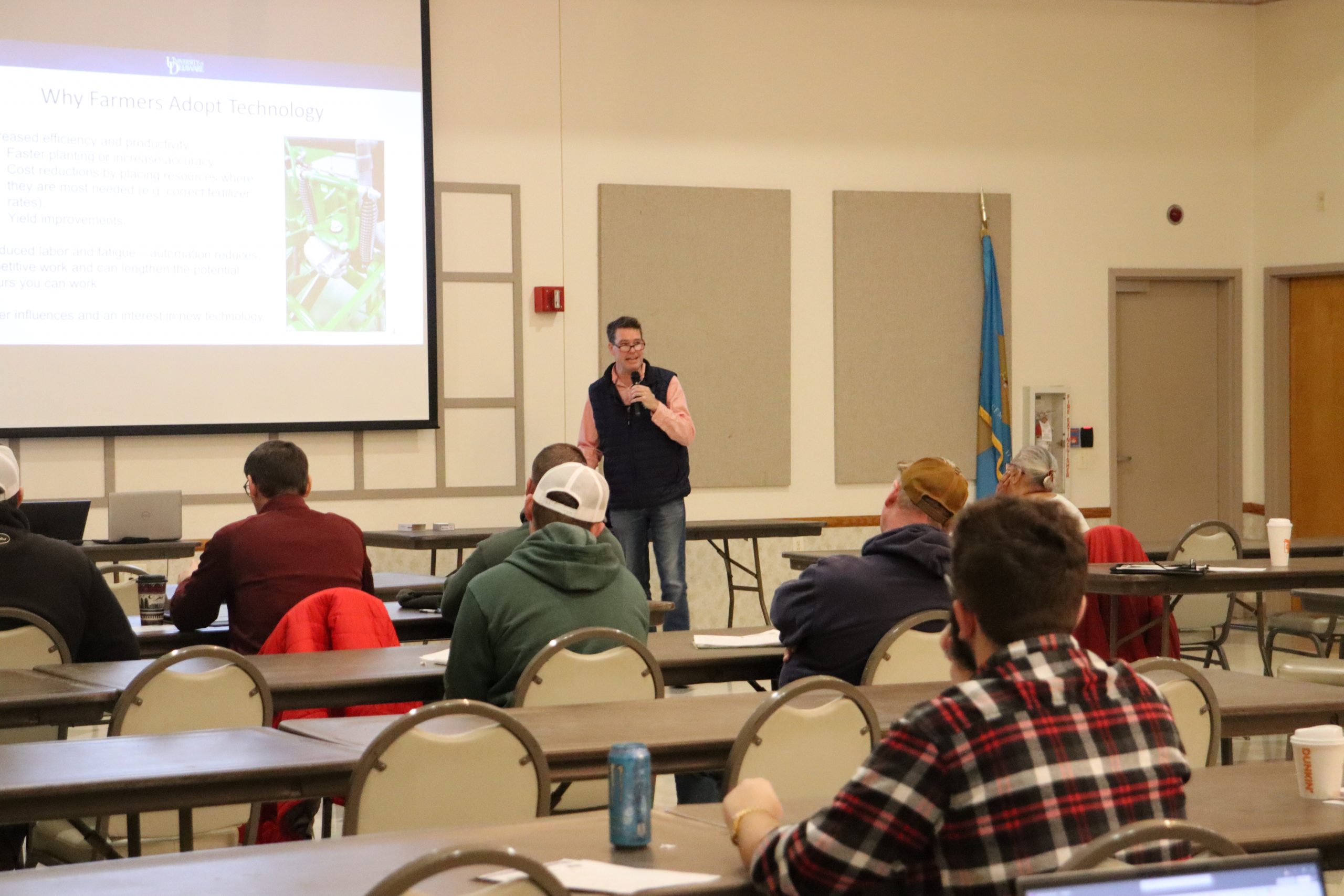
The University of Delaware (UD) Cooperative Extension and the Delaware Farm Bureau hosted a Risk Management Conference in Harrington on February 25, 2026. The conference provided attendees with practical strategies to reduce risks on their farming operations and strengthen their financial bottom line.
The morning opened with remarks from Delaware Secretary of Agriculture Don Clifton, who encouraged farmers to review their crop insurance options, especially in light of the newly released Crop Insurance Assistance. Kent County Farm Bureau President Jim Minner also welcomed participants, emphasizing the importance of continued education and proactive planning in agriculture.
Nate Bruce from the UD Cooperative Extension, presented the 2026 Commodity Crop Budgets and later introduced the economics of precision conservation. He explained how enterprise budgets support operational planning by helping farmers determine profitability and breakeven costs. He encouraged attendees to use Excel or farm management tools such as FAST Tools or Ag Decision Maker to support financial decision-making.
James Adkins and Jarrod Miller, also from the UD Cooperative Extension, discussed the economics of agricultural technology, outlining the differences between automated and data-driven technologies as well as traditional versus precision methods. They stressed the importance of understanding capital, labor, and time investment, noting that farmers should consider both the cost of adopting new technology and the expected timeline for return on investment.
Kevin Wooten of the U.S. Department of Agriculture (USDA) Risk Management Agency (RMA) provided an in-depth overview of crop insurance options. He highlighted recent updates to crop insurance provisions related to peppers and triticale, along with updates to premium subsidy rates for beginning farmers. Wooten also noted additional premium assistance and increased coverage levels now available to producers. For more information visit www.rma.usda.gov.
Dale Maurice Johnson from the University of Maryland presented a grain market outlook and reviewed commodity balance sheets. Johnson underscored the challenges of market prediction due to fluctuating local supply and demand.
Faith Parum, Economist for the American Farm Bureau Federation (AFBF), spoke on the economics of agricultural chemicals, noting that the United States used 10% of global fertilizer in 2021 and that shipping disruptions continue to influence pricing. She encouraged attendees to stay informed through AFBF’s Market Intel resources at www.fb.org/market-intel.
Maryann Reed of the Farm Service Agency provided an agency update highlighting their programs available. The Supplemental Disaster Relief Program (SDRP) program will be administered in two stages and applications for both stages are currently open through April 30. The Conservation Reserve Enhancement Program (CREP) encourages farmers and landowners to enroll in long-term conservation contracts, removing environmentally sensitive land from agricultural production and implementing conservation practices. She also encouraged attendees to reach out to their county offices for information on the Conservation Reserve Program (CRP). To learn more about FSA and their programs, visit www.fsa.usda.gov.
The conference concluded with a presentation from Kelly Sipple from UD on retirement planning options and Laurie Wolinski of UD and Jennifer Ford of the Mental Health Association of Delaware on ambiguous loss in agriculture. They explained that stress often builds gradually and can stem from unclear or compounding sources. Farmers, they noted, face constant uncertainty and demanding decisions, contributing to significant mental strain. They also highlighted the unique cultural challenges within agriculture, including strong self-reliance and limited safe spaces to discuss personal struggles.