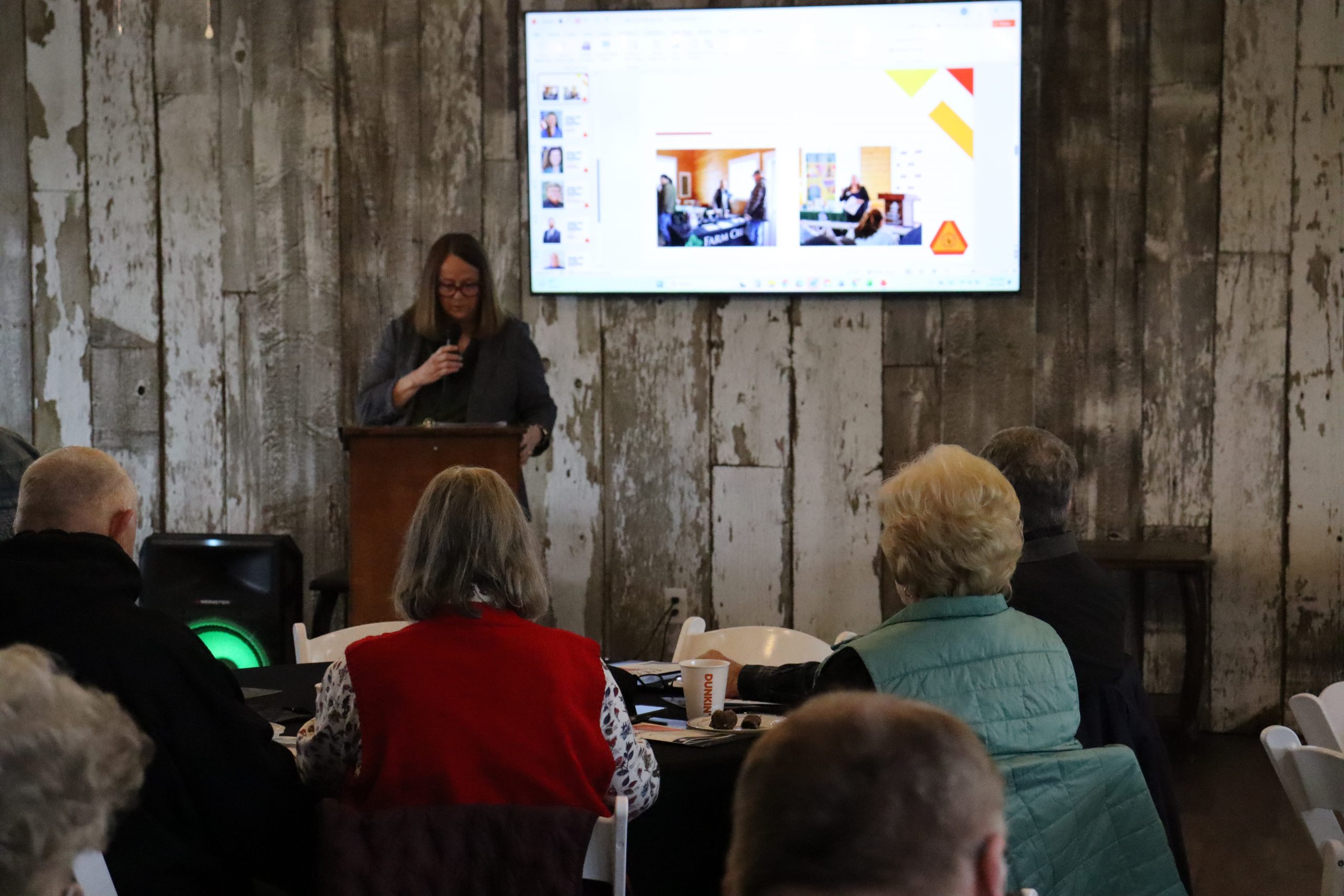
The Delaware Farm Bureau (DEFB) Promotion and Engagement Committee (P&E) held its ninth annual Delaware Ag Safety Conference on March 18 at the Pratt Farm Lodge. Conference Chair June Unruh opened the event by thanking participants for their dedication to promoting safety in Delaware agriculture and shared her “three P’s” for approaching safety: prevent the preventable, prioritize safety, and protect your living assets. Attendees from across the state then took part in sessions covering tick safety, proper livestock handling, fire extinguisher use, and preparing for unexpected on‑farm emergencies.
Ashley Kennedy, Delaware Department of Natural Resources and Environmental Control (DNREC) Tick Biologist, presented on tick biology, ecology, and safety in Delaware. She explained that DNREC’s tick program conducts year‑round surveillance and testing and provides resources to help identify the species found in the state. Kennedy highlighted four species of particular concern: the Longhorned Tick, American Dog Tick, Lone Star Tick, and Blacklegged Tick. She noted that the Lone Star Tick is associated with alpha‑gal syndrome, while the Blacklegged Tick, commonly known as the deer tick, can carry lyme disease and other pathogens. More information on tick safety is available at www.de.gov/ticks.
Susan Garey, Kent County Extension Director with University of Delaware (UD) Cooperative Extension, shared best practices for safe livestock handling. She emphasized the importance of remaining calm and quiet around animals, noting that their poor depth perception and blind spots can make them easily startled by sudden movements. Garey also explained that animals’ flight zones vary depending on level of tameness. She reminded attendees to never turn their backs on male animals, which are often more aggressive. She closed by encouraging everyone to “plan, prepare, and always be aware.” More information on UD Cooperative Extension can be found at www.udel.edu/academics/colleges/canr/cooperative-extension.
Chuck Snyder, Delaware State Fire School Field Instructor, offered guidance on the safe use of fire extinguishers. He reviewed the five classes of extinguishers:
- A – Ordinary Combustibles
- B – Flammable Liquids
- C – Electrical Equipment
- D – Combustible Metals
- K – Cooking Media (greases, fats, oils)
Snyder also provided a hands‑on learning experience using a fire extinguisher simulator. He advised participants to stand with their backs to the wind, six to ten feet from the fire, pull the pin, aim at the base of the flames, gently squeeze the lever, and sweep from left to right until the fire is fully extinguished. Snyder reminded attendees to check extinguishers annually and noted that metal extinguishers can be refilled. Additional information is available at www.statefireschool.delaware.gov.
Todd Givler, Nationwide Sr. Consultant Sponsor Relations, spoke on Nationwide’s newest campaign, Farm Risk Ready. His presentation focused on identifying and prioritizing the biggest risks on an operation and developing effective response plans. Givler stressed the importance of asking “what if?” to better prepare for unexpected events, noting that 65% of people do not have a formal emergency plan and instead take a “wait and see” approach. He explained that having established plans can also benefit insurance policies by demonstrating lower risk. Attendees were encouraged to review their preparedness strategies and take proactive steps. More information on Farm Risk Ready can be found at www.nationwide.com/lc/resources/farm-and-agribusiness/articles/farm-risk-ready.
Jimmy Hughes, Pesticide Program Manager and Sussex County Inspector with the Delaware Department of Agriculture (DDA), delivered a presentation on proper pesticide management. He outlined the steps required to become a Certified Pesticide Applicator and reviewed the ongoing training necessary to maintain certification. Hughes also discussed important safety precautions. such as proper handling and planning, when applying pesticides. Participation in his session provided attendees with one credit toward their certification renewal. For more information on the DDA Pesticide Management Program, visit www.de.gov/pesticides.
“It is very important to stay informed and work smart; don’t learn the hard way,” Unruh said as she praised attendees for prioritizing safety education. “Keep a safety checklist in your head, and learn it, use it, and share it.”
For more information on DEFB’s Safety Conference or Promotion and Engagement Committee contact DEFB Assistant Executive Director and Marketing Coordinator Mikayla Paul at mikayla.paul@defb.org, 302-697-3183, or www.defb.org.