By: Dillana Reed
As the nation observes America’s 250th anniversary, it is imperative to honor American agriculture, one of our country’s most enduring and influential industries. Throughout history, agricultural advancements helped to shape the nation’s economy, culture, and identity. In Delaware alone, this is not only reflected within our landscape but also within the development of the Delaware Farm Bureau, an organization that has played a critical role in supporting our farmers.
In the late 18th century farming used to be defined as a small family run operation, using manual labor and limited tools.The farms in Delaware followed this pattern, they relied on animal power, hand tools, and strong communities, to provide the labor needed to run the farm. A large majority of the population was involved in farming.
Agriculture began to shift in the 19th century. Mechanical equipment like the steel plow and reaper were introduced, which helped farmers increase their productivity. Railroads expanded which allowed for more market access. These improvements helped lay the groundwork for a more interconnected and commercially oriented agricultural system.
As farming began to modernize and become more complex, so did the challenges that farmers faced. Farmers were faced with fluctuating prices, limited access to necessary supplies, and a need for reliable information about newer agricultural practices. Across the country many cooperative organizations emerged to try and address some of these issues. These cooperatives are what led to the formation of the Delaware Farm Bureau.
County Farm Bureaus were first established in the early 1900s by county extension agents as a way to promote the modern farming techniques and education programs extension agents provided. Delaware Farm Bureau was organized in 1920 and the first official president was W.V. Cosden.
During this time Delaware Farm Bureau was also considered a purchasing cooperative which helped to enable the local farmers to pool resources in order to buy seed, fertilizer, and equipment at a fraction of the normal cost. However, individuals that were not members of the Delaware Farm Bureau began using this purchasing cooperative without actually contributing any dues which caused significant strain and eventually led to the bureau’s disbandment. In 1926, the Delaware Farm Bureau was forced to dissolve.
Although it was disbanded, the need for a unified voice for agriculture did not disappear. As farmers navigated the Great Depression, wartime production needs, and technological changes the value of an organized group protecting farmers’ interests became increasingly clear. The number of farms in this time period was drastically dropping and farm size was rapidly growing. Farmers were navigating different challenges and new business models.
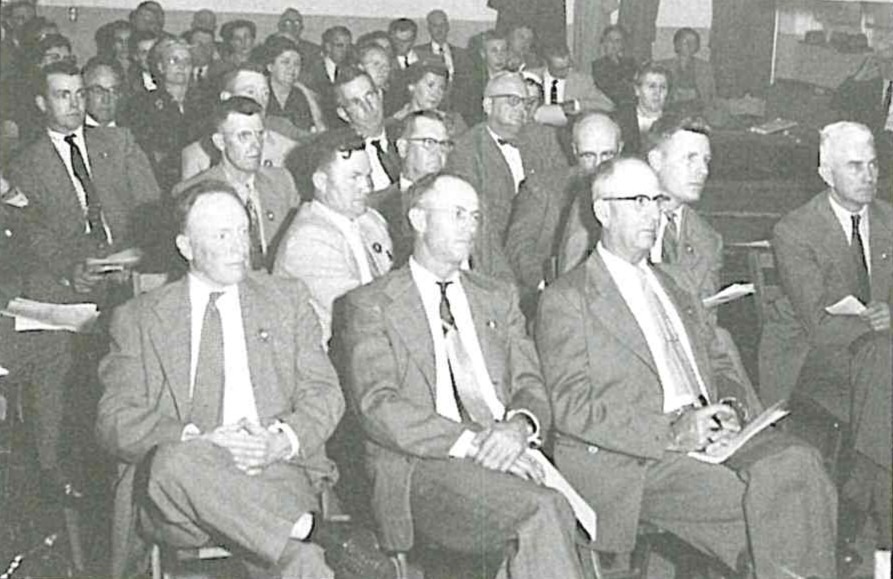
In 1944, the Delaware Farm Bureau reorganized with a drive to protect Delaware agriculture and gain membership. The organization was able to quickly reestablish itself as it was a vital advocate for the farmers in the area, as well as crucial for policy development, educational programs, and strengthening the community. The first president of DEFB was George Simpson of Houston, under his leadership the organization looked to unify the farmers, strengthen their communication, and promote shared problem solving.
Modern American farms currently bear little resemblance to their colonial start. Many modern farms now rely on machinery, data-driven decision making, and a global market. Delaware was able to diversify itself with its production of poultry, produce, and grains, all of which have formed the backbone of our state’s farming economy.
Although there have been many changes, many of the core values for both farmers and the Delaware Farm Bureau have remained unchanged: cooperation, community, and a commitment to helping local producers. Delaware Farm Bureau stands as a testament to the strength of our agricultural community. From its early days to its modern role as a statewide advocate, the organization has helped shape the identity of Delaware farming. Its history reminds us that agriculture is not just an industry; it is a living tradition, carried forward by generations who work the land, support one another, and adapt to the changing world around them.